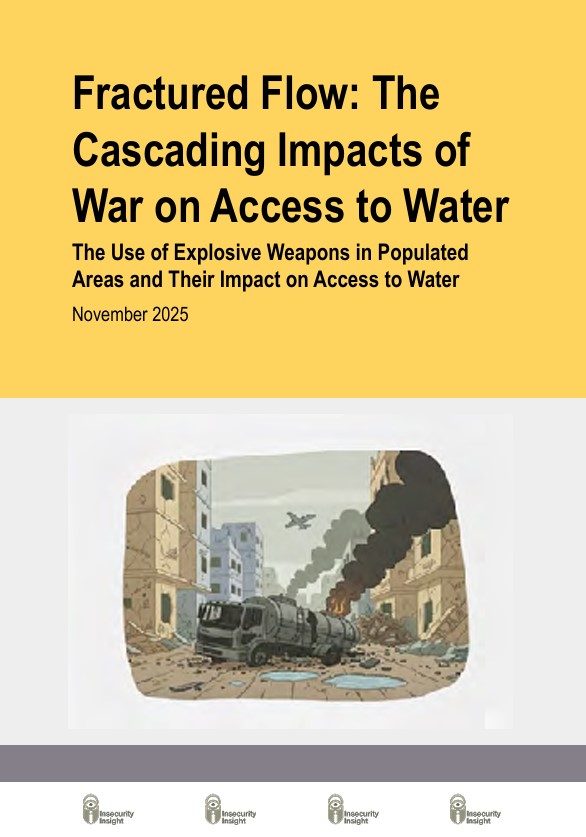
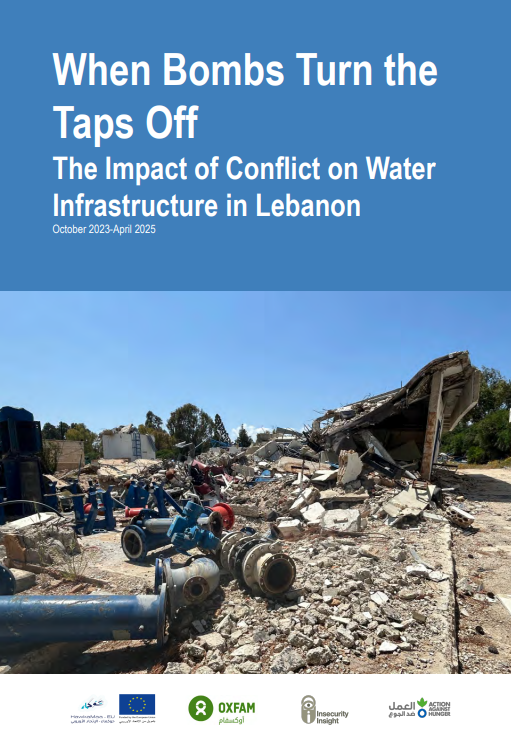
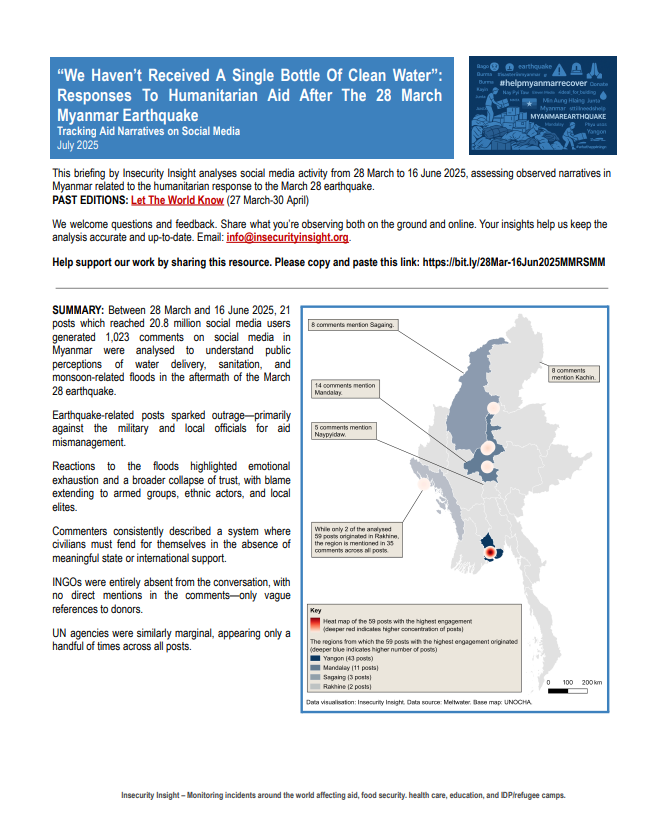
Insecurity Insight systematically documents incidents affecting water systems and their reverberating impacts on civilians and essential services, including public health, healthcare, education, food security, and humanitarian operations in 15 countries covering data since 2018, providing an evidence base to identify patterns, understand conflict-related impacts, and assess humanitarian consequences for civilian populations and critical infrastructure.
Protecting civilians in armed conflict requires safeguarding access to essential services, including water, sanitation and hygiene (WASH). Conflict-related violence affecting water systems can have immediate and life-threatening consequences by disrupting access to safe water, while also generating reverberating effects across public health, healthcare, education, food security, livelihoods, and humanitarian operations. These interconnected impacts often extend well beyond the initial incident, compounding vulnerabilities and undermining the resilience of affected communities.
15 countries and territories covered: Burkina Faso, Cameroon, the Democratic Republic of the Congo (DRC), Iraq, Lebanon, Mali, Myanmar, Niger, the occupied Palestinian territory (oPt), Somalia, South Sudan, Sudan, Syria, Ukraine and Yemen.
Reports are available below and data is accessible on the Humanitarian Data Exchange (HDX).
- Home
- About us
- Press Releases
- Projects
- SIIM
- Security Incident Information Management (SIIM) (EN)
- Security Incident Information Management (SIIM) FR
- Security Incident Information Management (SIIM) (ES)
- Security Incident Information Management (SIIM) AR
- SIIM in NGO Security Collaboration
- Toolkit: Evidence that Protects Health Care
- Support for Advocacy
- Mobile Guides and Podcasts
- Mobile guides on security
- Research partnership
- Concept development
- The SiND Database
- Definitions and Methodologies
- Country Pages
- Website archive