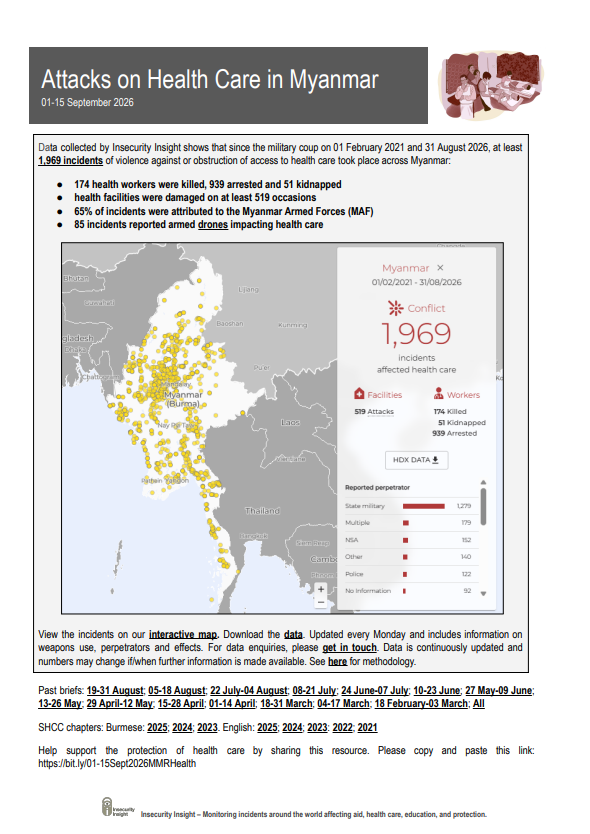
Attacks on health care violate international humanitarian law. Using open source intelligence methods and contributions from aid agency partners, Insecurity Insight monitors such attacks. Updates are available in the News Briefs and data is accessible on the Humanitarian Data Exchange (HDX). Incidents can also be viewed on our interactive map for global attacks on health care and the map for Ukraine covering incidents since Russia’s full-scale invasion in February 2022. Our wider work is outlined below. Ten years after the adoption of UN Security Council Resolution 2286, attacks on health care in conflict zones continue at alarming levels.
Still Under Attack: A Decade of Monitoring Attacks on Health Care after United Nations Security Council Resolution 2286 examines a decade of violence against health workers, hospitals, ambulances, and patients, highlighting the human cost of these violations and the persistent gap between international commitments and action. It calls for stronger accountability, protection of medical services, and renewed global efforts to safeguard health care in times of conflict.
Care in the Crosshairs: Violence Against Health Care in Conflict: In 2025, the Safeguarding Health in Conflict Coalition (SHCC), using data collected by Insecurity Insight, documents 2,546 incidents of violence against or obstruction of health care across 33 countries in 2025, including 790 incidents where hospitals were damaged or destroyed and 455 health workers killed. The report includes detailed profiles of 21 countries and territories where many acts of violence against health care took place across Africa, Asia, the Middle East and Europe and the Americas.
Impact of Attacks on Health Care: Insecurity Insight works with the Humanitarian and Conflict Response Institute at the University of Manchester, UK, on the Researching the Impact of Attacks on Healthcare (RIAH) project. This aims to improve understandings of the nature, frequency, scale, and impact of attacks on health care in conflict.
Security Risk Management for Health Care (SR4H) Handbook: Provides guidance on how to implement a range of actions intended to promote respectful and violence-free environments and prepare individuals or organisations to face and respond appropriately to violent incidents, also dealing with the aftermath of such events. Available in Arabic, English, French and Spanish.
Risk Management Measures: The security incident information management (SIIM) portal, an Insecurity Insight project, provides guidance and tools for aid organisations – including those involved in the provision of health care in conflict environments – to improve understandings and approaches to SIIM.
Attacks on Responses to Health Crises: Insecurity Insight monitors attacks on health responses to COVID-19 and has previously documented these in relation to Ebola.